
Coconino Arrest Log Is Unofficial
Start with what the county itself offers. The Sheriff's jail inmate FAQ states plainly that inmates are not listed on the county website. Flagstaff Police, Page Police, and Williams Police take the same approach. Quarterly booking reports exist, but they count statistics rather than naming people. City records pages simply hand you request channels, not a running archive of arrests.
That leaves local news. The FlagScanner Area Arrest Logs archive publishes dated posts describing selected people booked into the Coconino County Detention Facility over a stated span. Some entries pull together more than one day, which helps after a weekend. FlagScanner is news, not government. Posts appear irregularly with gaps between them, so treat the archive as partial coverage rather than a complete daily roster of Coconino County arrests.
Browsing the source category shows that irregular rhythm directly. Dated posts stack up in the archive, some clustered tight together and others spaced days apart.
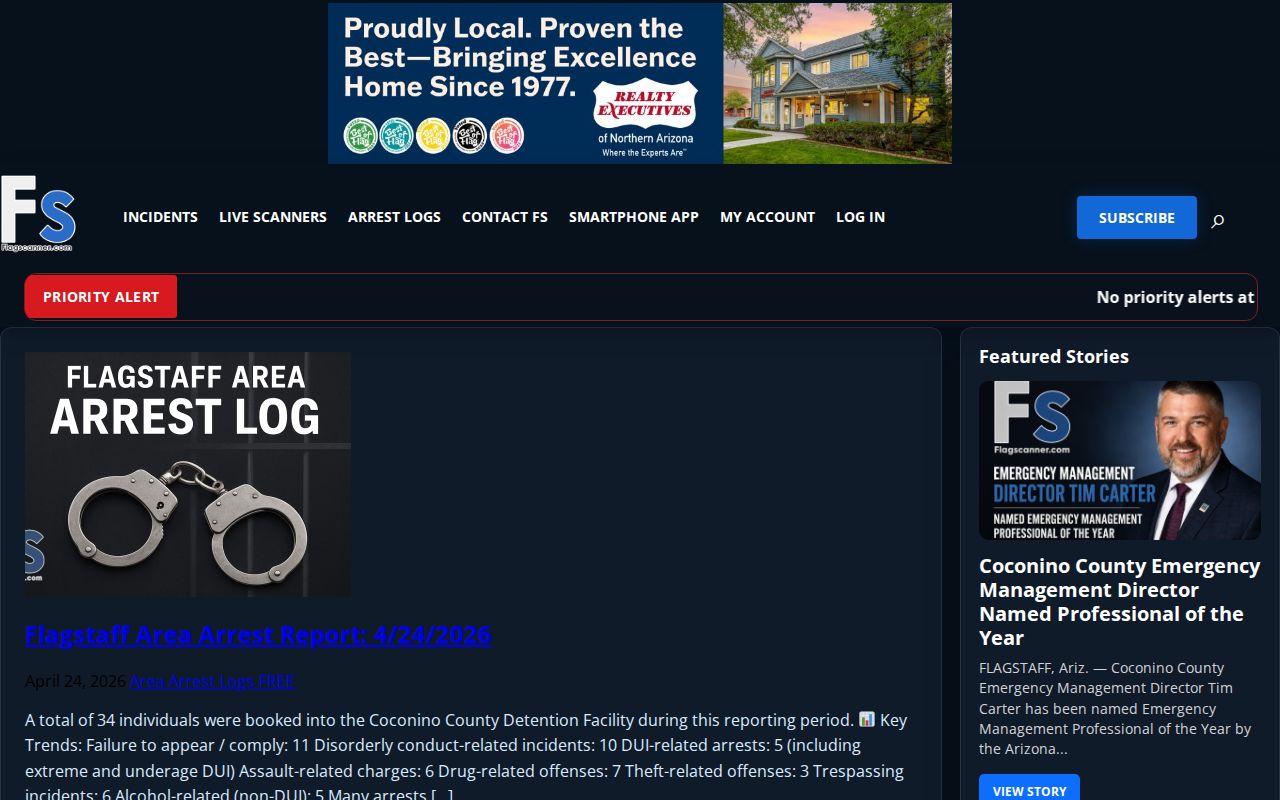
What you are looking at is a news archive, not a county roster of current inmates. Every name in it still needs confirmation through the detention facility or Records before it means anything official.
Read the Coconino County Blotter
Read the coverage period printed inside each post first. The article date alone can mislead you, since a multi-day log may reach back several days at once. That reach is exactly what makes the blotter handy for working backward through recent Coconino County bookings, especially when a same-day item was posted late. Just remember what it is. A discovery tool points you toward a name. It does not settle who remains in custody.
- Open the Area Arrest Logs category and select a post whose stated booking period overlaps the date in question.
- Read the source note and charge disclaimer. Note the name, booking date and time, and charge text exactly as printed.
- Call the Flagstaff jail at 928-226-5200, or Page at 928-645-8873 for northern temporary holding, to ask about current custody.
- Request the underlying booking or arrest record through the consolidated Flagstaff Police and Coconino Sheriff Records Section when a stable document is needed.
- Use the responsible court to trace later filings and the final disposition.
Look-alike names cause real trouble. Two different people booked the same week can share a surname or a close spelling, and the log rarely carries enough identity detail to settle the match. A booking number, date of birth, or report number from an official record beats any third-party photo or search snippet every time.
For same-day results, the Coconino County 24 Hour Arrests page explains why calling the detention facility works better than waiting on a news post.
Coconino Arrest-Log Entry Fields
The sample FlagScanner log keeps its fields lean. Names, booking times, and charges appear, but plenty of data living in the county records system never makes the page. Read each field for exactly what it says. When a question reaches past that, use the source named in the final column.
| Log item | Meaning and limit | Verification source |
|---|---|---|
| Name | Identifies the person as printed; similar names remain possible | Booking record or jail staff |
| Booking date/time | Reported intake time, not the article publication time | Coconino booking record |
| Charge text | Charge recorded at booking; it can change | Court docket and final disposition |
| Stated period | Dates the article says it covers, not a completeness promise | Post text and archive dates |
| Photo | No general county booking-photo gallery was verified | Records request if releasable |
| Current custody | Not established by an archived post | Flagstaff or Page detention phone |
Some answers require the official file. The arresting agency, the event location, bond, release reason, and court assignment often sit beyond what a blotter prints. Keep in mind that the agency making the arrest can differ from the agency doing the booking, and both can differ from the facility currently holding the person. Coconino's regional detention system serves local, state, and federal authorities alike, which widens the mix further.
Note: The charge shown in a sample log is simply what was booked at the time, not the final word from any court.
Coconino Weekend Posting Gaps
FlagScanner publishes no fixed posting hour, no weekend schedule, and no promise of 72-hour coverage. That irregularity shapes how you should read it. A Monday post may fold in an earlier booking, several short posts may land in quick succession, or a date may get no post at all. The category archive keeps an article alive after it leaves the home page, though nothing there guarantees permanence. Holidays scramble the picture further, since police work, jail booking, court filing, records processing, and news publication each run on their own clock. A person can be booked while the article is still unwritten, and a stale post can linger long after a release.
The sound sequence is simple. Discover by date, confirm with the detention facility, then request the formal record. The official report request form asks for the report number if known, the date and time, the location, the nature of the event, and person details. Records staff reach out once responsive material is ready.
Coconino Arrest Archives and Retention
The FlagScanner category holds posts from 2025 and 2026, but archive depth has no stated limit. Search engines keep serving old snippets, and an article can outlive the accuracy of its information by years. Flip side matters too. A missing post proves nothing about whether a booking happened, and it says nothing about whether an official record still exists.
Official files follow public-body retention schedules, not the lifespan of a news link. The Arizona State Library records schedules cover law-enforcement holdings, and records tied to pending litigation or ongoing investigation may need extended retention. When your period falls outside the visible archive, ask the Records custodian which schedule applies and request the specific booking or report by name and date.
Older court files take a separate path. The Coconino Superior Court Clerk maintains court records, while some much older Superior Court material transfers to the State Archives. A court archive tells you how a case ended. It cannot rebuild a live jail roster.
Coconino News Blotter Patterns
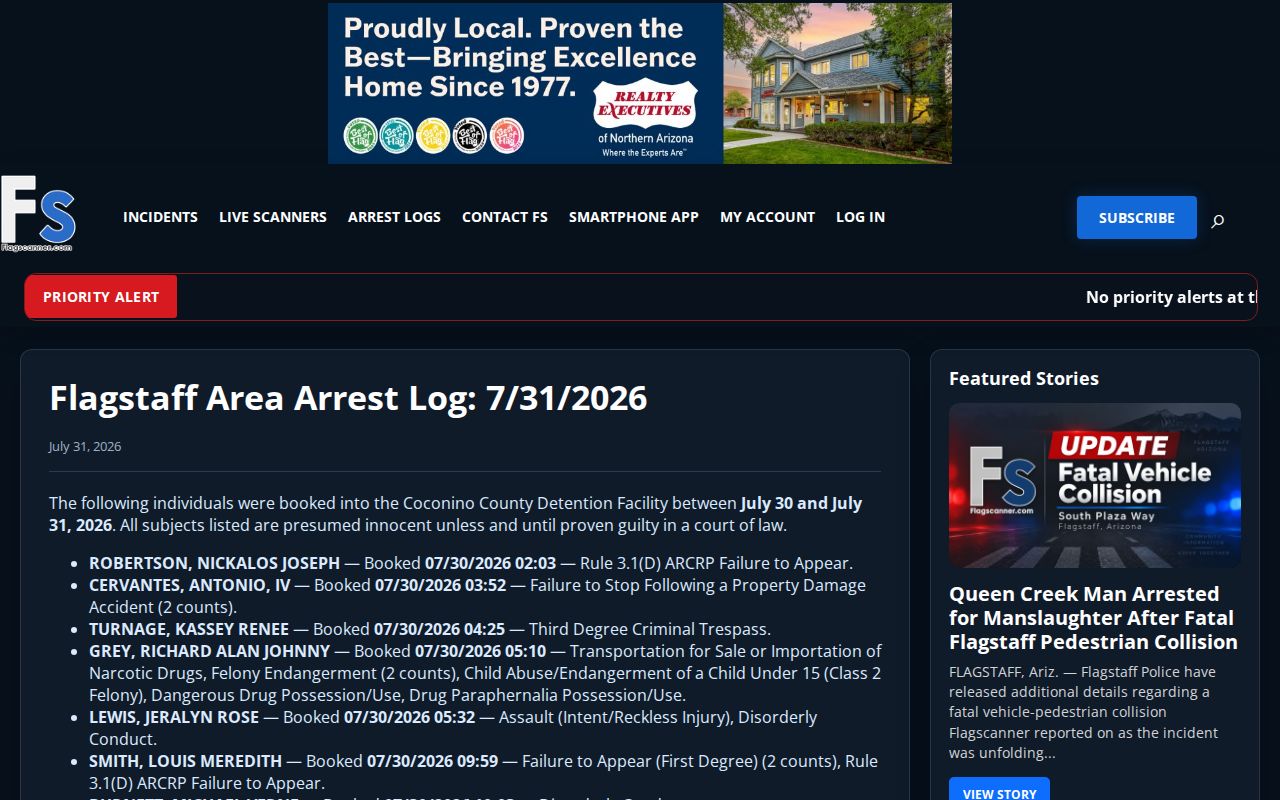
A sample FlagScanner arrest log notes that its entries were compiled from publicly available records provided by the Coconino County Detention Facility. It prints names, times, and charges in a text-led format. That sourcing makes the log solid secondary local reporting, useful for spotting who was arrested in the area, but never a stand-in for the county itself. The original July 31 log carries its own context and source note for anyone who wants the full picture.
Arizona Daily Sun and Williams News carry selected public-safety stories for the Flagstaff area, while the Page and Lake Powell market gets similar event-based coverage. Neither outlet maintains a full Coconino booking log or a standing mugshot gallery. A dated headline can point you toward an arrest, but it is only a starting point.
News stories lag and they leave things out. For current custody status or missing booking details, the jail itself is the reliable source, along with the Records unit and the court handling the case.
Coconino Booking Reports Differ
Coconino County releases quarterly jail booking and re-entry reports, but those documents answer a different question than a daily arrest log. They count bookings, individuals, and charges as separate figures. The reports also sort bookings into categories like court commitments, warrants, remands, prisoners in transit, and print-and-mug activity. So a booking total is never simply a headcount of people in the jail.
The agency trend reports work the same way. They chart patterns across Flagstaff Police, the Sheriff's Office, Page Police, and other departments without naming who is currently held. They are useful for understanding how the county's arrest and booking workload shifts over time, not for finding a specific person.
One more wrinkle deserves attention. A single arrest can carry several charges, and one person can be booked more than once in a quarter. Charges, bookings, and unique people are three different numbers. Check each report's definitions, exclusions, and date range before comparing any of them, and never treat one total as a stand-in for another.
- Booking
- The jail intake event after an arrest, court order, or other authorized custody action.
- Remand
- A court order placing a person in custody.
- Disposition
- The court's final outcome for a charge or case.
- Release
- Departure from jail custody, which does not by itself end the court case.
Coconino Arrest Allegations and Court Results
A booking entry marks a custody event, nothing more. Prosecutors can amend or decline charges, and courts can dismiss counts down the line, so the final outcome may look nothing like the first jail entry.
Arizona Public Access Case Lookup tracks the later case trail, though it updates weekly and excludes protected or sealed categories. The county Clerk's eAccess services cover eligible Superior Court cases. For the official result, go to the court holding the file.